What your team sends to AI. And what it sends back.
Zeflin governs your whole AI data boundary: what sensitive data leaves for AI tools, and what AI content comes back.
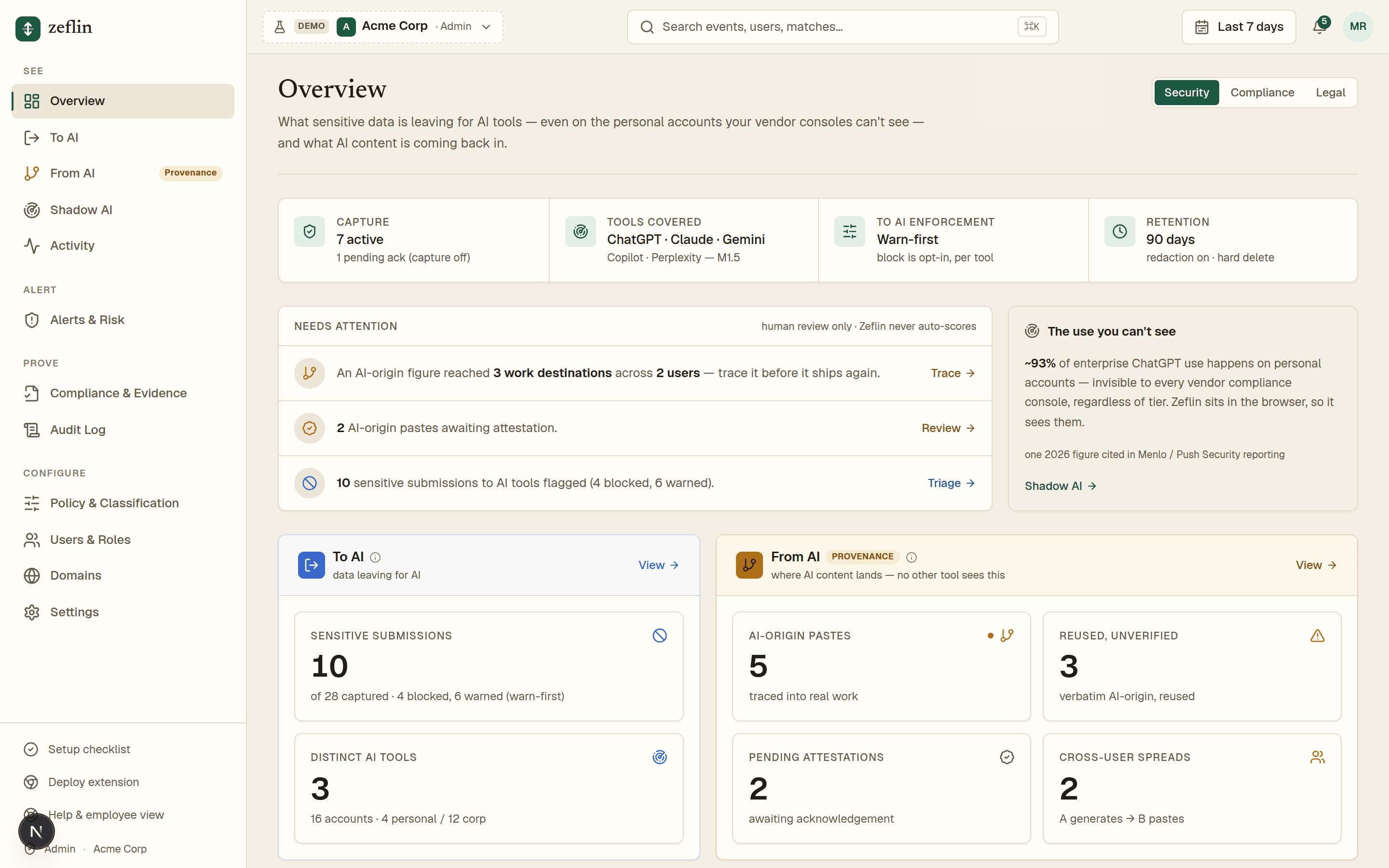
Covers the AI tools your team already uses. Copilot and Perplexity next.
Your AI vendor's console can't see personal accounts. And nothing sees where AI output goes after the chat window.
of employees use free-tier ChatGPT-style tools on personal accounts, invisible to every vendor compliance console.
Menlo Security, 2025 Report — corroborated by Verizon DBIR 2026 (67%)
of employees admit pasting sensitive data into public AI tools, and rely on AI output without verifying what comes back.
Anagram, 2025 (58% out) · KPMG / Univ. of Melbourne, 2025 (66% in)
One boundary, both directions.
Most tools watch data going out. Zeflin watches both, and enforces them differently on purpose.
Redact sensitive data before it leaves
Everything employees send to AI tools is classified by Google Cloud DLP. Sensitive data is redacted before the prompt is sent (default), and whole tools can be blocked. Redacting a credential before it reaches ChatGPT — without blocking the employee's work — is exactly what you want.
Enforcement: redact by default, tool-block opt-in
Trace AI content coming back in
When AI output lands in Gmail, Docs, Slack, or Jira, Zeflin matches it to the captured response and shows where it spread, and who should attest. We never block AI content from landing in someone's work.
Enforcement: monitor, warn, attest only. Never blocked.
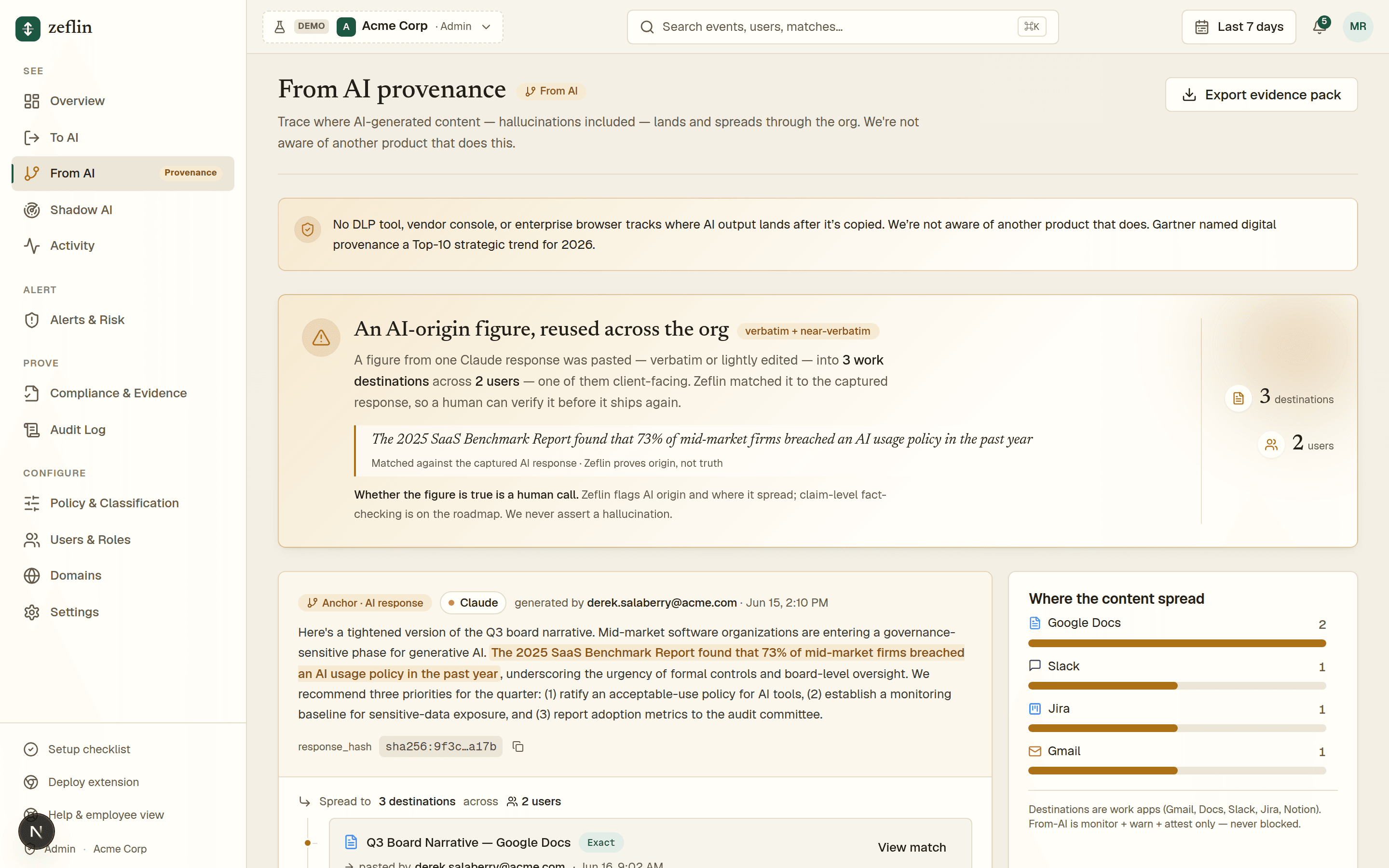
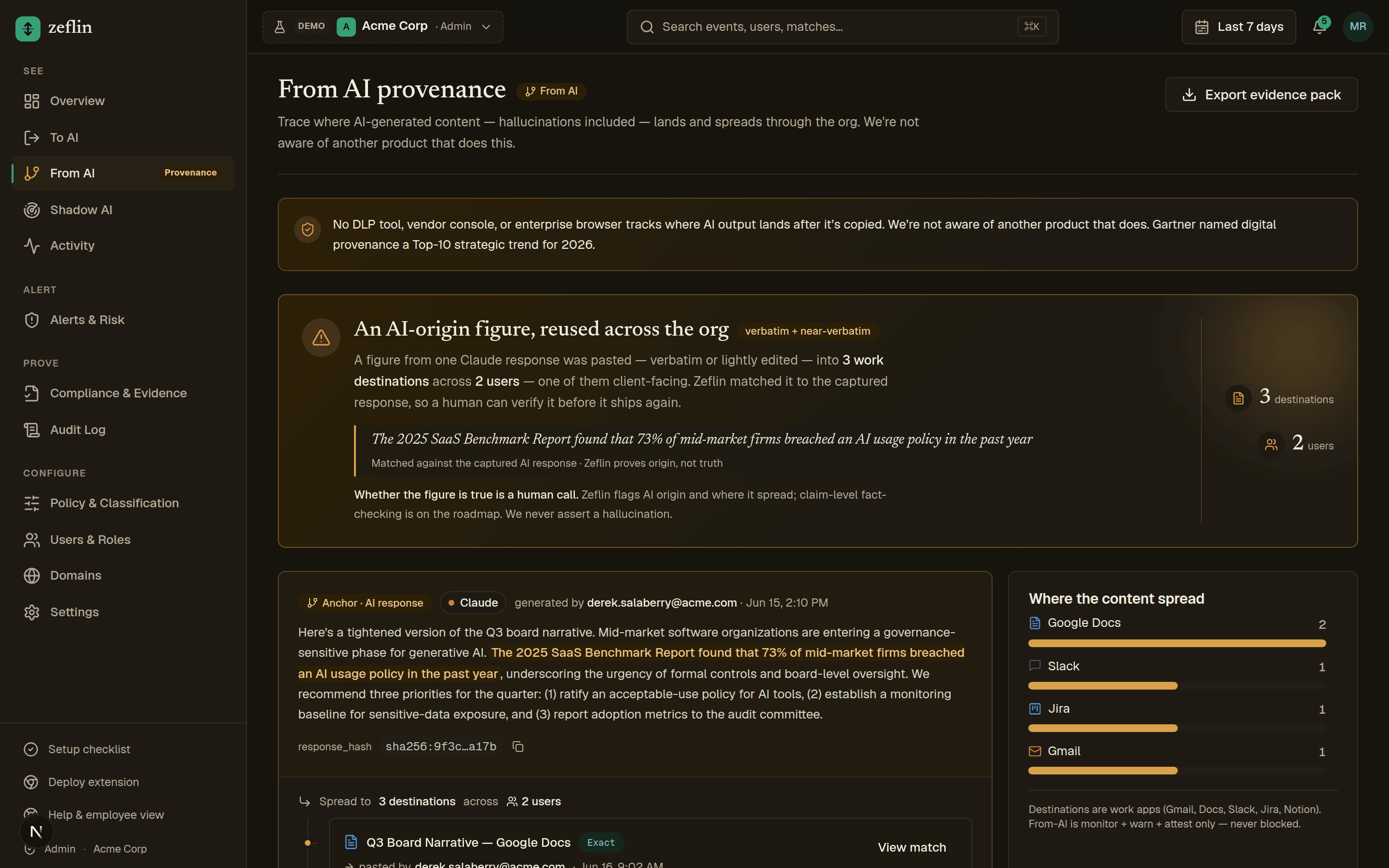
The first tool that traces how AI content spreads.
We capture AI responses at the source, then match everywhere that content surfaces across your work apps against them. You see one response fan out across documents and people, flagged for a human to verify before it ships again. We flag AI origin. People verify the truth.
Outbound DLP, vendor consoles, and enterprise browsers watch what goes out to AI. Zeflin follows what comes back — the first to trace where AI-generated content lands across your work apps, and how it spreads between people.
The inbound risk is real, dated, and expensive.
documented court cases involving AI-hallucinated content, 1,146 of them in the US.
Charlotin AI Hallucination Cases database, June 2026
in sanctions against two attorneys for fabricated citations, at the appellate level.
Whiting v. City of Athens, 6th Cir., March 2026
(AU$440k) government report partially refunded after hallucinated references were found in it.
Deloitte Australia, October 2025
Every one was discovered after the content shipped, by a judge, a client, or a journal. Zeflin surfaces AI-origin content as it lands, so a human catches it first.
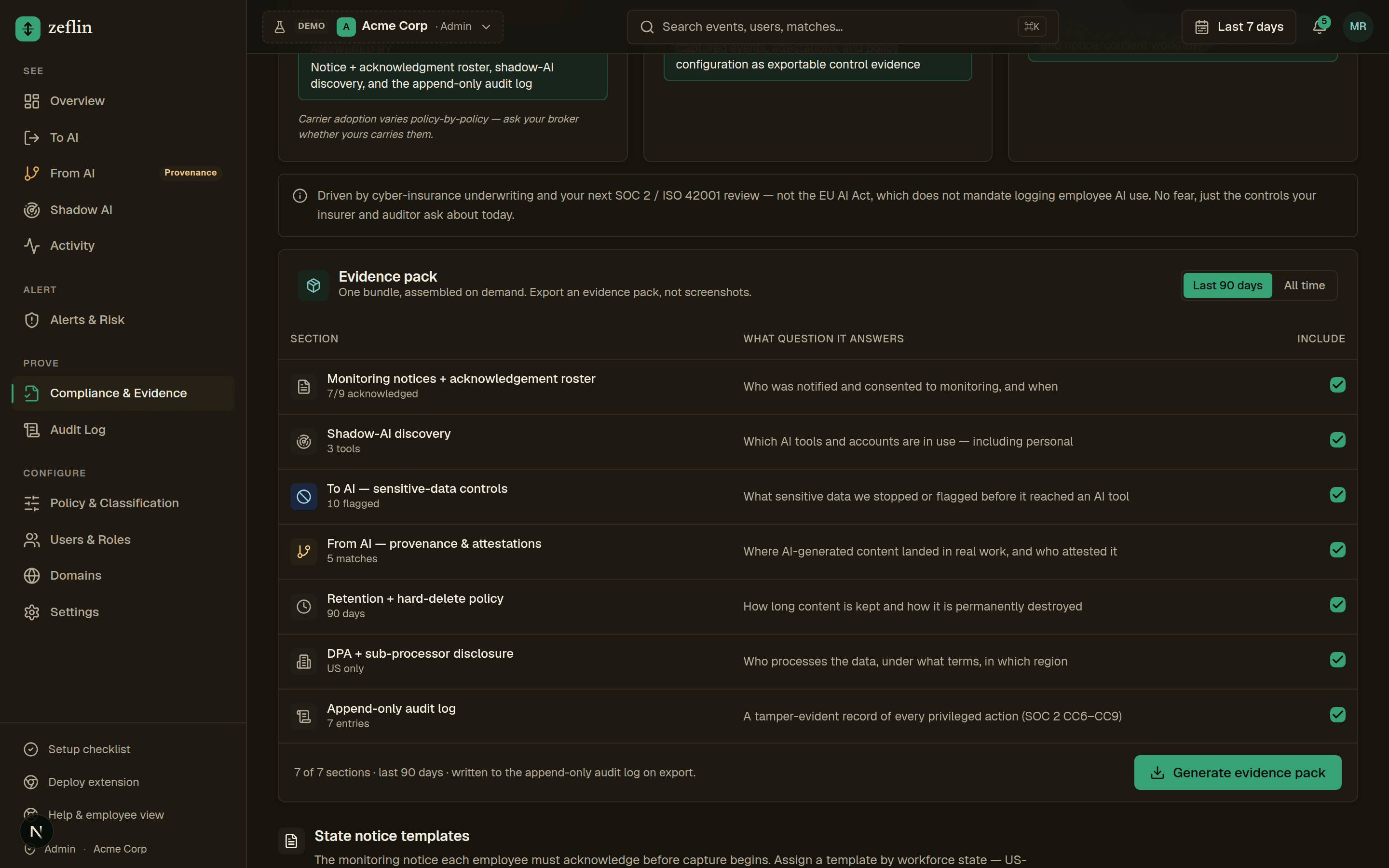
When your insurer or auditor asks about employee-AI controls, you have the answer.
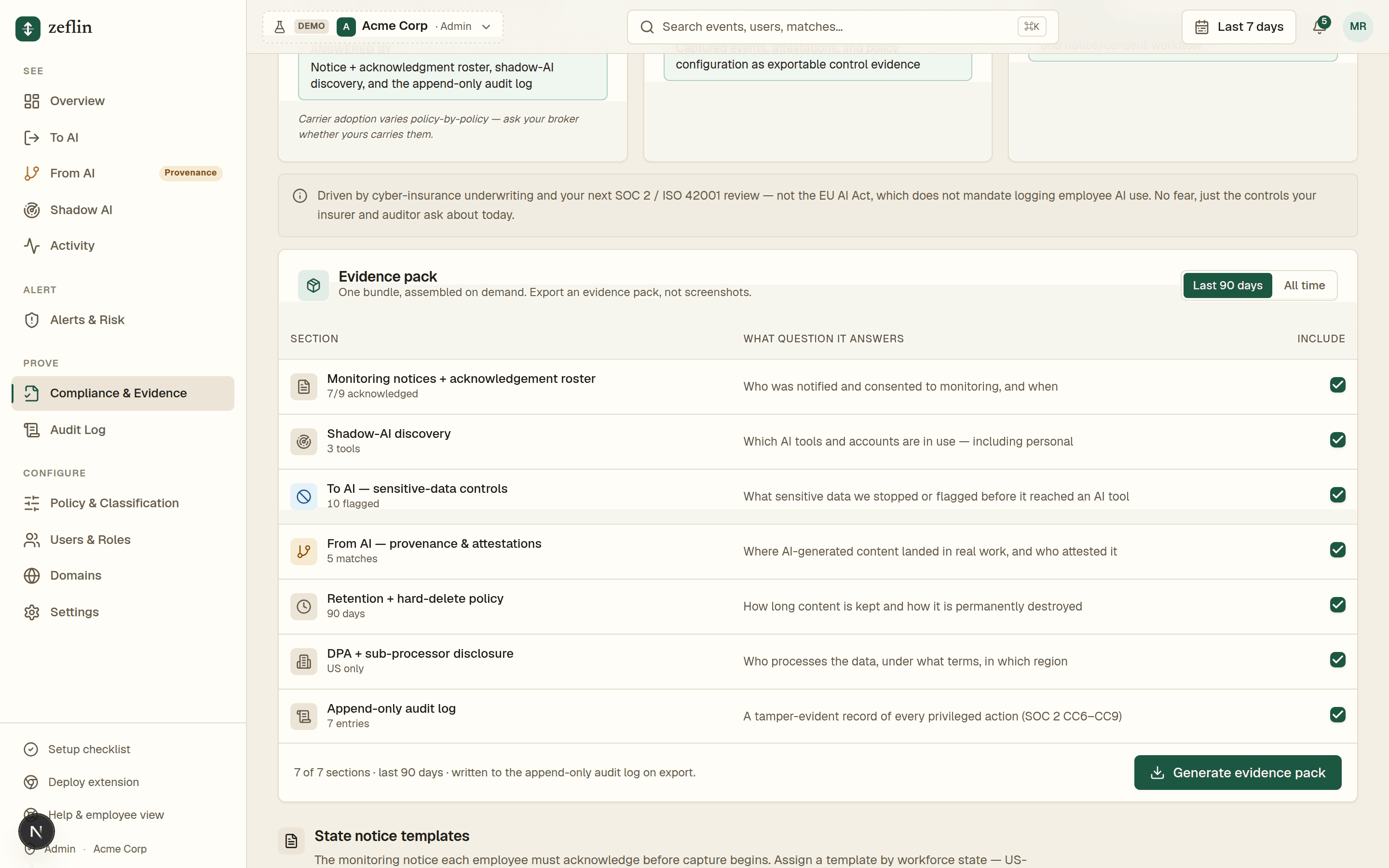
All three drivers ask the same question. Zeflin's logs, attestations, and policy are the programmatic evidence. Export an evidence pack, not screenshots.
Insurers filed Generative-AI exclusion forms effective January 2026, and cyber underwriting questionnaires now ask about employee-AI controls.
Auditors now expect programmatic AI-control evidence under the existing criteria (CC6 to CC9), not screenshots.
A growing share of enterprise buyers screen vendors for AI-management posture before they sign.
The pressure is your insurance renewal and your next SOC 2 audit, not the EU AI Act, which does not mandate logging employee AI use. No fear, just the controls your insurer and auditor ask about today. Carrier adoption varies, so ask your broker.
A five-minute install, not a six-month rollout.
Deploy in minutes
Push the Chrome extension through Google Workspace or Intune. No agents, no proxies, no endpoint project.
Capture turns on with consent
It activates per employee only after they acknowledge the monitoring notice. The notice and consent workflow are built in.
Warn, attest, and prove
Outbound warnings, inbound attestations, and a one-click evidence pack for insurers and auditors.
Guardrails, not surveillance theater.
Full capture is a serious responsibility, so the safeguards ship from day one, and we are honest about what the product does not do yet.
Encrypted, then deleted
Captured content is encrypted at rest and hard-deleted on a retention TTL. No archive.
No ack, no capture
Capture activates per employee only after they acknowledge the monitoring notice.
Work is never blocked
AI content landing in your own email and docs is never blocked. A human decides, never an auto-score.
Yours to delete
Per-employee export and verified hard delete handle DSARs without engineering.
Become a design partner.
We are running a small number of free pilots with US companies. You get the full product, a hands-on rollout, and a pilot with success criteria we agree on together. We get a design partner who shapes what we build.
- Free, with no card and no commitment
- Hands-on Workspace or Intune rollout
- A pilot scoped to your own success criteria